(WASHINGTON) — Less than a week after the Environmental Protection Agency repealed its own endangerment finding, which gave the agency authority to regulate greenhouse gas emissions, a coalition of health and environmental organizations sued the agency over its decision.
The case, filed in the U.S. Court of Appeals for the District of Columbia Circuit, is being brought by the American Public Health Association, the American Lung Association, the Center for Community Action and Environmental Justice, Physicians for Social Responsibility, the Union of Concerned Scientists, the Center for Biological Diversity, the Natural Resources Defense Council and the Sierra Club, among others.
The lawsuit names EPA Administrator Lee Zeldin and the EPA as defendants.
Made during the Obama administration, the 2009 decision found that certain greenhouse gases endanger public health and welfare. The regulations that resulted cover everything from vehicle tailpipe emissions to the release of greenhouse gases from power plants and other significant emission sources.
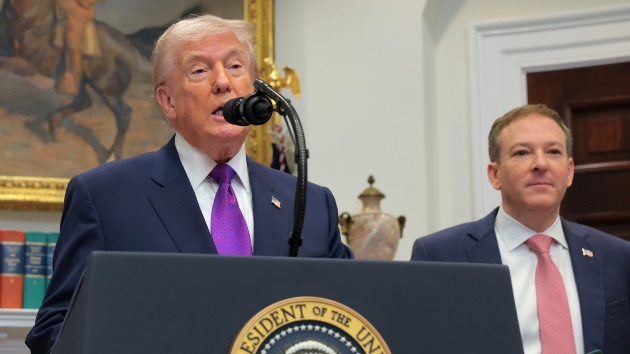
President Donald Trump announced the repeal at the White House last Thursday, alongside Zeldin.
“The Endangerment Finding has been the source of 16 years of consumer choice restrictions and trillions of dollars in hidden costs for Americans,” Zeldin said in a statement at the time.
The litigants in the case say that “Under the Clean Air Act [CAA], the EPA is legally required to limit vehicle emissions of any ‘air pollutant’ that the agency determines ’cause or contribute to air pollution that may reasonably be anticipated to endanger public health or welfare.’ “
The coalition says the Trump Administration is “rehashing legal arguments” that were already rejected by the Supreme Court in its 2007 Massachusetts v. EPA case.
“Unlike our predecessors, the Trump EPA is committed to following the law exactly as it is written and as Congress intended — not as others might wish it to be,” the agency said in a statement to ABC News.
The agency said it “carefully considered and reevaluated the legal foundation of the 2009 Endangerment Finding, the text of the CAA, and the Endangerment Finding’s legality in light of subsequent legal developments and court decisions,” specifically highlighting Supreme Court decisions in 2024’s Loper Bright Enterprises v. Raimondo and 2022’s West Virginia v. EPA.
“The agency concluded that Section 202(a) of the CAA does not provide EPA statutory authority to prescribe motor vehicle emission standards for the purpose of addressing global climate change concerns,” it said.
Without that authority, the agency said “the Endangerment Finding is not valid, and EPA cannot retain” resulting regulations.
“EPA is bound by the laws established by Congress, including under the CAA,” the statement said. “Congress never intended to give EPA authority to impose GHG regulations for cars and trucks.”
Copyright © 2026, ABC Audio. All rights reserved.