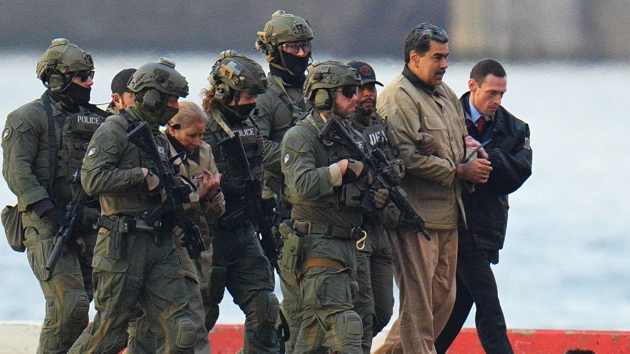
(NEW YORK) — After three months in jail, ousted Venezuelan President Nicolas Maduro appeared thinner and grayer, but still in command, as he appeared in federal court in Manhattan for a status conference on Thursday.
Maduro — was shackled at the ankles and wearing a beige smock over an orange shirt — nodded to the gallery and said “good morning,” in English.
Judge Alvin Hellerstein said he would not dismiss the narcoterrorism and other charges Maduro faces, but appeared to wrestle with how to assure Maduro had access to sufficient counsel.
The defense argued the case must be tossed because the Treasury Department had not given the government of Venezuela a special license to fund Maduro’s defense with funds subject to U.S. sanctions.
“I’m not going to dismiss the case,” Hellerstein said. However, the judge questioned the national security need for sanctions now that Maduro is no longer in charge and he and his wife, Cilia Flores, are in American custody.
“I see no abiding interest in national security in the right to defend yourself,” Hellerstein said. “The right to defend is paramount.”
A federal prosecutor said Maduro should not be allowed to use Venezuelan funds after he was accused of plundering the country’s wealth.
“A defendant has no right to spend a third party’s money,” prosecutor Kyle Wirshba said.
Defense attorney Barry Pollack said the quality of Maduro’s defense would suffer with court-appointed counsel, whose taxpayer-funded resources are often limited.
Pollack said the allegations “against these defendants occurred in Venezuela.”
Hellerstein agreed that defending Maduro would come at “great expense” and deplete the resources of most public defenders.
“Truthfully, we have no case like this,” Hellerstein said.
President Donald Trump said at a Cabinet meeting Thursday that he was hopeful that additional charges will be brought against Maduro and said Maduro should be charged for facilitating the transport of people and drugs into the U.S.
“I hope that charge will be brought at some point,” Trump said.
“He emptied his prisons into our country and was a major purveyor of drugs coming into our country. … I would imagine there are other trials coming,” Trump said.
Maduro and his wife pleaded not guilty to federal charges including narco-terrorism during their first appearance in court in January, and their attorneys have since pushed to have the case dismissed over concerns that the Trump administration is blocking the Venezuelan government from paying their legal fees.
For more than a decade, Maduro enjoyed an opulent life as Venezuela’s president, living in the neoclassical palace in Caracas and accruing a net worth reportedly in the millions. He allegedly owned multiple mansions, two private jets, millions in jewelry and cash, a horse farm, and a fleet of luxury vehicles.
But he’s pushing to have his case dismissed by arguing he doesn’t have enough money to pay for his own legal defense — and his lawyers argue his due process rights will be violated if Venezuela is unable to pay for his lawyers because of U.S. sanctions on the country.
“I understand that the government of Venezuela is prepared to fund my legal defense and it is my expectation that it will,” Maduro said in a sworn declaration. “I have relied on this expectation and cannot afford to pay for my own legal defense.”
As the Trump administration gradually warms relations with Venezuela, Thursday’s hearing marks the second time that the ousted Venezuelan leader has appeared in a U.S. courtroom since special operations forces captured him in Caracas in January.
The Department of Justice initially brought an indictment against Maduro and 14 other Venezuelan officials in March of 2020, arguing they committed narco-terrorism by conspiring with drug cartels to allow the flow of cocaine into the United States.
Nearly six years later, prosecutors filed a new indictment charging Maduro, Flores, Maduro’s son, and three others with narco-terrorism conspiracy, cocaine importation conspiracy and weapons offenses.
Maduro “sits atop a corrupt, illegitimate government that, for decades, has leveraged government power to protect and promote illegal activity, including drug trafficking,” the indictment said.
Prosecutors alleged that Maduro allowed “cocaine-fueled corruption to flourish for his own benefit,” including by providing diplomatic cover to drug traffickers and money launderers. Maduro has pleaded not guilty and denies being involved in drug trafficking.
“[Maduro] is at the forefront of that corruption and has partnered with his co-conspirators to use his illegally obtained authority and the institutions he corroded to transport thousands of tons of cocaine to the United States,” the indictment said.
-ABC News’ Emily Chang, Michelle Stoddart and Fritz Farrow
Copyright © 2026, ABC Audio. All rights reserved.